
When comparing the projectile mechanics of bows versus firearms, you aren’t just looking at two different weapons—you are looking at two entirely different philosophies of physics. As we move through 2026, advancements in materials science have pushed the limits of both traditional archery and modern ballistics. Understanding how these systems launch a projectile requires a deep dive into energy transfer, aerodynamics, and the subtle forces that dictate accuracy.
The Science of Energy Transfer: Elastic Potential vs. Chemical Combustion
At the core of the bow vs gun projectile mechanics debate lies the mechanism of acceleration. A bow acts as an elastic energy storage system. When you draw a bowstring, you are performing work, storing potential energy in the limbs. Upon release, this energy is converted into kinetic energy and transferred to the arrow.
Conversely, a firearm utilizes chemical energy through the rapid combustion of propellant. This creates high-pressure gas that drives the bullet forward. While a firearm is significantly more efficient at converting raw energy into velocity, the bow relies on the Archer’s Paradox—a fascinating phenomenon where the arrow bends around the riser upon release.
Arrow Flight and the Archer’s Paradox
In archery, the projectile is not rigid. Because the bowstring is released off-center, the arrow undergoes significant oscillation. Research suggests there are at least 14 modes of movement associated with an arrow in flight. To stabilize this, arrow fletching plays a critical role. By creating drag at the rear of the shaft, fletching ensures the arrow maintains a straight trajectory despite the initial “wobble” caused by the launch.
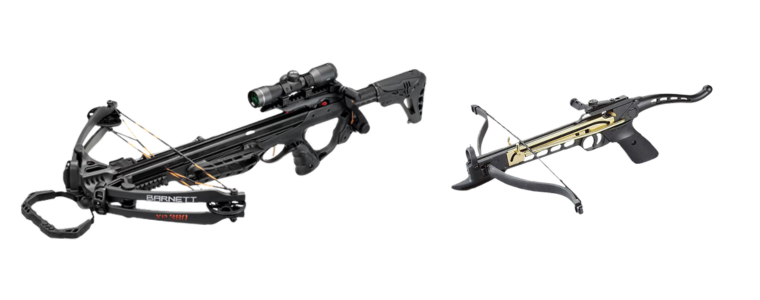
In contrast, bullets fired from a modern rifled barrel gain stability through gyroscopic rotation. The “spin” imparted by the rifling keeps the bullet pointed forward, minimizing the need for the complex stabilization required by an arrow. This fundamental difference is why firearms are inherently easier to master for long-range precision in 2026.
Ballistic Coefficients and Drag
When analyzing bow vs gun projectile mechanics, we must consider how each projectile handles air resistance. The ballistic coefficient (BC) is a measure of a projectile’s ability to overcome air resistance in flight.
- Bullets: Generally possess a much higher BC, allowing them to retain velocity over hundreds or even thousands of yards.
- Arrows: Possess a low BC due to their large surface area and fletching. They shed velocity rapidly, making them short-range tools by comparison.
However, the “stopping power” of an arrow is often misunderstood. Because arrows are heavier and have a larger cross-sectional area, they achieve deep penetration through momentum rather than the hydrostatic shock typically associated with high-velocity bullets.
The Impact of Modern Materials in 2026
The year 2026 has seen a surge in high-modulus carbon fiber shafts and aerospace-grade alloys for bow limbs. These advancements have narrowed the efficiency gap. Modern compound bows can now store energy more effectively, reducing the “hysteresis” or energy loss that plagues elastic systems.

While firearms continue to benefit from smart-optic integration and advanced propellants, the physics of the bow remains a masterclass in mechanical engineering. Experimentation remains essential for understanding how variables like draw weight, spine stiffness, and fletching angle affect the final flight path.
Key Differences at a Glance
To summarize the technical divergence between these two methods of propulsion:
- Acceleration Phase: Bows have a long, gradual acceleration phase; firearms have a near-instantaneous, high-pressure spike.
- Stability: Arrows rely on aerodynamic damping (fletching); bullets rely on gyroscopic stability (rifling).
- Efficiency: Firearms convert chemical energy to kinetic energy at a much higher percentage than the elastic limbs of a bow.
- Trajectory: Bullets follow a relatively flat path; arrows follow a pronounced parabolic arc due to lower velocity and higher drag.
Conclusion
Whether you are a marksman or an archer, the physics governing your projectile are constant. While the gun dominates in terms of velocity, range, and ease of use, the bow offers a unique challenge that requires a deep understanding of structural oscillation and energy transfer. As we look at the technological landscape of 2026, both disciplines continue to evolve, proving that whether you use combustion or elasticity, the goal remains the same: mastering the flight of the projectile.