
Physics can often feel like a complex web of abstract variables and daunting equations. For students grappling with kinematics, the projectile motion calculator has become an indispensable digital companion. As we move through 2026, the demand for precision, speed, and conceptual clarity in physics coursework has never been higher. Whether you are prepping for a lab report or studying for an AP physics exam, knowing how to leverage these free online tools can turn hours of manual calculation into seconds of insight.
Why Use a Projectile Motion Calculator in 2026?
The core of classical mechanics lies in understanding how objects move through the air under the influence of gravity. A projectile count calculator for physics students—often referred to as a trajectory simulator—does more than just provide a final number; it demystifies the relationship between initial velocity, launch angle, and gravity.
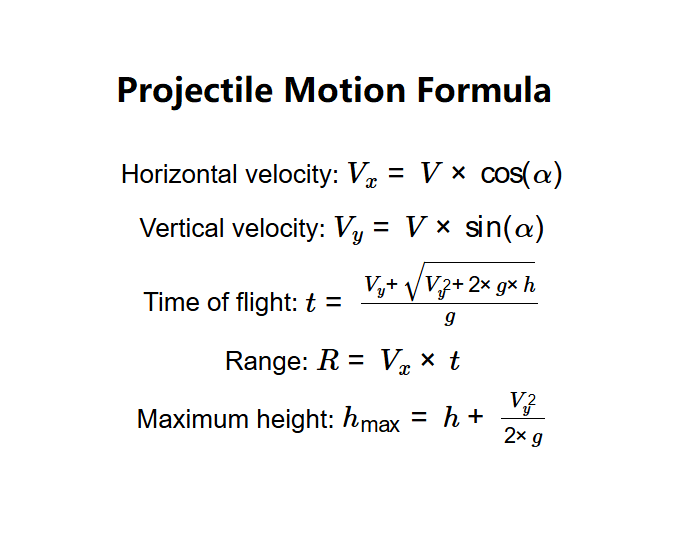
By using a free online physics calculator, students can instantly verify their handwritten work. This immediate feedback loop is essential for mastery. Instead of guessing if your math is correct, you can visualize the parabolic path and ensure your variables for horizontal range, maximum height, and time of flight align with physical reality.
Essential Features to Look For
Not all calculators are created equal. When searching for the best tool to assist with your studies, prioritize platforms that offer more than just a basic input/output field. In 2026, top-tier calculators should provide:
- Adjustable Gravity: Essential for students comparing experiments on Earth versus other planets or localized environments.
- Initial Height Variables: Many basic calculators assume a launch from ground level ($y=0$). Advanced tools allow you to account for launch platforms or cliff-side experiments.
- Animated Visualization: Seeing the trajectory move in real-time helps bridge the gap between abstract numbers and physical mechanics.
- Step-by-Step Equations: The best tools don’t just give the answer; they display the kinematic equations used to derive the result, which is vital for exam preparation.

How to Maximize Your Results
To get the most out of your free projectile motion simulator, you must understand the inputs. Most calculators require three fundamental variables:
- Initial Velocity ($v_0$): The speed at which the object leaves the launch point.
- Launch Angle ($theta$): The angle relative to the horizontal plane.
- Gravity ($g$): Usually set to $9.81 , text{m/s}^2$ for Earth-based problems.
Once these are entered, the simulator will output the total range (how far it travels), the peak height, and the time of flight. If you are performing a lab, try adjusting the launch angle incrementally (e.g., 15°, 30°, 45°, 60°) to observe how it affects the distance—a classic physics experiment that proves the 45-degree angle provides the optimal range on flat terrain.
Integrating Digital Tools into Your Study Routine
Effective studying is about efficiency. Using a projectile motion calculator shouldn’t be a shortcut to avoid learning; it should be a tool to enhance your understanding. Follow these steps to maximize your learning:
- Predict First: Before entering numbers into the calculator, perform a rough estimation or a manual calculation using the relevant kinematic formulas.
- Check Against Reality: Use the simulator to see if your prediction was close. If not, re-examine your algebraic steps.
- Experiment with Variables: Change the initial height or gravity to see how the trajectory shape changes. This fosters a deeper intuition for mechanics that simple memorization cannot provide.

Recommended Resources for 2026
If you are looking for the most reliable calculators to support your 2026 physics curriculum, these platforms are highly recommended by educators:
- Simulations4All: Excellent for students who want to visualize trajectories with interactive sliders.
- MiniWebtool: A robust option that supports advanced inputs like custom gravity and initial height, making it perfect for complex lab reports.
- Free Online Physics Calculator: A straightforward, no-nonsense tool that provides instant, formula-backed results for quick homework checks.
Conclusion
Physics is a discipline of observation and verification. By utilizing a projectile count calculator for physics students free of charge, you are equipping yourself with the same analytical power used by engineers and researchers. Remember, these tools are at their best when they serve as a complement to your conceptual understanding. In 2026, let technology do the heavy lifting of calculation so you can focus on the beauty of the physics behind the flight.
Whether you are calculating the flight time of a basketball or the trajectory of a projectile in a vacuum, these digital tools ensure you stay ahead of the curve. Keep exploring, stay curious, and keep calculating!