
In the high-fidelity landscape of 2026 gaming, the distinction between hitscan and projectile weapon systems has never been more critical. As competitive shooters evolve toward higher tick rates and more complex environmental physics, understanding the underlying math of your favorite gun is no longer just for developers; it is a prerequisite for any player looking to climb the ranked ladders. Whether you are playing a tactical extraction shooter or a fast-paced arena FPS, knowing how your shots register can be the difference between a triumphant victory and a frustrating miss.
At its core, the debate between hitscan and projectile mechanics is a fundamental design philosophy that dictates the entire flow of combat. While hitscan offers the crisp, instant gratification of precision, projectile systems introduce a layer of tactical anticipation that rewards deep game knowledge. In this guide, we explore the engineering, balance, and player psychology behind these two systems in the modern gaming era.
The Mechanics of Hitscan: Instantaneous Feedback in Modern Shooters
Hitscan is defined by the absence of travel time. When a player pulls the trigger on a hitscan weapon, the game engine performs a raycast operation. This is a mathematical line projected from the camera or weapon muzzle to the target. If that line intersects with a hitbox at the exact moment of the input, the damage is calculated and applied immediately. In 2026, hitscan remains the gold standard for high-precision weapons, such as sniper rifles, designated marksman rifles, and standard assault rifles.
The primary reason developers favor hitscan for these weapon types is consistency. In a competitive environment, players demand a 1:1 relationship between their reflex and the game’s outcome. Because hitscan ignores distance and velocity, it eliminates the unpredictable nature of network jitter or packet loss on the bullet’s trajectory. By removing these variables, developers ensure that the player’s mechanical skill—specifically their crosshair placement—is the sole arbiter of success.
From an optimization standpoint, hitscan is also computationally efficient. It requires minimal server-side overhead because the game does not need to calculate the position, velocity, or collision of an object over time. This efficiency allows developers to allocate more server resources to other complex systems, such as advanced destruction physics or high-fidelity character animations, which are staples of 2026 titles.
Projectile Physics: The Complexity of Anticipation
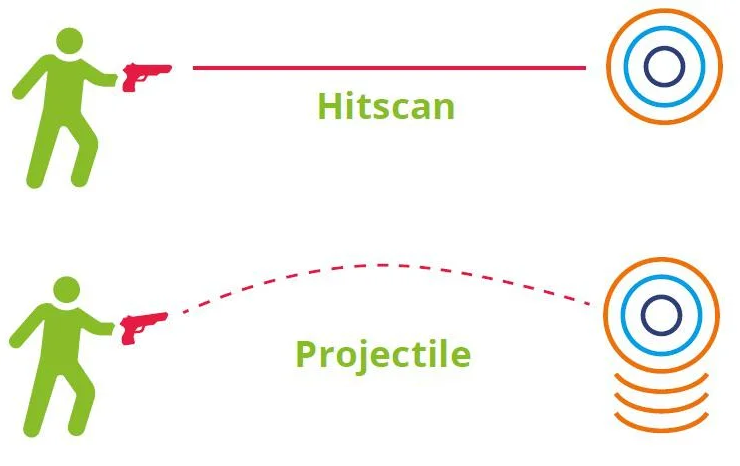
Projectile mechanics treat every bullet, bolt, or rocket as a physical entity within the game world. Once fired, the projectile is governed by physics-based simulation, which accounts for velocity, gravity, and in some hyper-realistic simulations, wind resistance and air density. This forces the player to engage with the game at a deeper level; they must account for the “travel time” of their projectile by leading their targets—aiming where the enemy will be, rather than where they are.
In 2026, projectile systems have become significantly more sophisticated. Modern game engines now utilize asynchronous physics calculation to ensure that even with hundreds of projectiles on screen, the game remains stable. This mechanic is essential for weapon variety. Without projectiles, it would be impossible to create distinct weapon archetypes like grenade launchers, slow-moving plasma rifles, or long-range ballistic snipers that require bullet drop compensation.
The strategic advantage of projectiles lies in the skill expression they demand. By forcing players to predict enemy movement, developers can create weapons that are devastatingly powerful but difficult to land. This creates a balanced risk-reward loop: a player may have a rocket launcher that can clear a room in one shot, but the slow travel time gives opponents a window of opportunity to dodge or utilize defensive utility.
The Impact of Netcode and Tick Rates in 2026

The 2026 gaming landscape is defined by the push for 128-tick servers and sub-20ms latency targets. This technological leap has changed how we perceive the hitscan vs. projectile divide. In the past, “ghost bullets”—shots that appear to hit but fail to register—were often blamed on the projectile system. Today, improved server-side reconciliation and client-side prediction have made projectile weapons feel nearly as snappy as their hitscan counterparts.
However, the underlying conflict remains. Hitscan is still heavily favored in “twitch” shooters where the time-to-kill (TTK) is measured in milliseconds. In these titles, any amount of travel time would feel sluggish or unresponsive. Conversely, in tactical shooters that emphasize positioning and movement, projectile systems are used to enforce a skill-based pacing. If every weapon were hitscan, movement would be largely punished; by using projectiles, designers allow for “evasive maneuvers” as a viable defensive strategy.
Balancing Gameplay Loops: Why Designers Choose One Over the Other
Game design is an exercise in constraint. When choosing between hitscan and projectile, developers consider the combat loop of their title. A tactical shooter, which aims for realism, will almost always opt for hitscan for small arms fire to mimic the high velocity of modern firearms. In contrast, an arena shooter or a hero shooter will mix both to differentiate roles.
Consider the “Hero Shooter” sub-genre, which has dominated the 2026 market. These games rely on asymmetric balance. A character designed to be a high-precision sniper might be given a hitscan weapon to guarantee effectiveness at long range. Another character, perhaps a support or area-denial specialist, might be given a projectile weapon that deals high damage but is difficult to hit at range. This forces players to choose characters not just for their abilities, but for their weapon mechanics.
Furthermore, projectiles allow for environmental interaction. A hitscan bullet cannot be shot down by another player, but a projectile can. In 2026, many games allow players to use defensive abilities to destroy incoming projectiles, adding a layer of counter-play that simply does not exist with hitscan systems. This adds a level of depth that keeps the competitive meta evolving throughout the year.
The Future of Weapon Mechanics: Hybrid Systems
As we look toward the latter half of the decade, we are seeing the rise of hybrid systems. These weapons function as hitscan at close range—where the velocity is so high that travel time is imperceptible—but transition into projectile behavior at extreme distances. This is a brilliant design choice that mitigates the frustration of missing shots due to network latency while still allowing for long-range bullet drop and travel time mechanics.
This hybrid approach is becoming the standard for open-world shooters and battle royale games. It provides the “snappy” feel that players desire for close-quarters combat while maintaining the strategic depth of long-range sniping. By blending these two technologies, developers are successfully balancing the need for accessibility with the demand for a high skill ceiling.
How Hitscan Affects Your Aiming Technique
When playing with hitscan weapons, your focus should be on micro-adjustments and tracking. Because the shot is instantaneous, you do not need to compensate for the enemy’s movement speed. Instead, you must develop the muscle memory to flick your crosshair to the target’s center mass or head at the exact moment of the trigger pull. Success with hitscan is entirely dependent on your raw mechanical speed and your ability to predict the enemy’s movement pathing.
Mastering Projectile Weapons: The Art of Leading
Projectile weapons require a shift in mindset. You are no longer aiming at the enemy; you are aiming at the intersection point where the enemy will be when the projectile arrives. This requires you to internalize the velocity of your specific weapon. Each weapon in a game has a different “projectile speed” stat. Advanced players in 2026 use a combination of “tracking” (following the target) and “prediction” (calculating the lead) to ensure their shots land consistently.
Frequently Asked Questions
1. Is hitscan always better than projectile weapons?
No. While hitscan is more consistent for precision, projectile weapons allow for more diverse gameplay, such as area denial, target leading, and the ability for opponents to dodge or destroy incoming fire. The “better” choice depends entirely on the game’s intended pace and tactical depth.
2. Can a projectile weapon be made to feel like a hitscan weapon?
Yes, by increasing the projectile velocity to a high enough value, the travel time becomes virtually indistinguishable from hitscan to the human eye. Many modern games use this “high-velocity projectile” approach to maintain consistent physics while providing the feel of instant impact.
3. Why do some games have “ghost bullets” even with hitscan?
Ghost bullets are typically a result of network latency (ping) or poor server-side hit registration. Even if your client-side game shows a hit, the server may have already moved the target based on its own simulation. In 2026, developers use “rollback netcode” to minimize these discrepancies, but they can still occur in high-latency environments.
4. How do I practice leading my shots for projectile weapons?
The best way to practice is through dedicated training maps or “aim trainers” that allow you to adjust projectile speed. Start by focusing on targets moving at a constant speed and distance, then gradually increase the complexity by introducing erratic movement patterns to build your predictive intuition.
Conclusion
The debate between hitscan and projectile weapons is a cornerstone of modern game design. By choosing one, developers set the tone for the entire player experience. Hitscan provides the immediate, high-octane precision that defines competitive shooters, while projectile mechanics offer the strategic depth and physical complexity that reward veteran players. As technology continues to advance in 2026, the lines between these two systems are blurring, leading to more sophisticated, hybrid weapon systems that offer the best of both worlds. Whether you prefer the instant satisfaction of a sniper rifle or the calculated mastery of a rocket launcher, understanding how your weapon interacts with the game engine is the first step toward true mastery of the battlefield.
Tags: hitscan, projectile, fps-mechanics, game-design, competitive-gaming
Category: Gaming Technical Analysis